The search “labiaplasty cost mexico” has grown steadily as patients compare US cosmetic surgery prices to medical tourism options. Mexico advertises labiaplasty at $1,500 to $3,000, dramatically lower than typical US pricing of $4,500 to $9,000. The savings appear substantial on surface comparison. The reality of medical tourism labiaplasty involves significantly more considerations than price alone, and the full cost of ownership often eliminates or reverses the apparent savings.
This guide provides an honest comparison between labiaplasty in Mexico and labiaplasty in the United States, covering real cost comparisons including complications and revisions, quality variation in both countries, logistics realities, and when medical tourism may or may not make sense. For comprehensive US labiaplasty cost data, see our average cost of labiaplasty breakdown and detailed Miami labiaplasty cost 2026 guide.
What Is the Price Comparison Really?
Advertised pricing comparisons show dramatic differences, but the apparent savings often disappear when total costs are honestly accounted for.
Advertised Mexico Pricing
Labiaplasty in major Mexican medical tourism destinations (Tijuana, Mexico City, Cancun, Guadalajara) typically advertises at $1,500 to $3,000. This covers surgeon fee, facility, and basic anesthesia. Promotional packages sometimes include transportation and recovery accommodation.
Advertised US Pricing
Miami labiaplasty typically $4,500 to $9,000. This covers surgeon fee, surgical facility, anesthesia, and typical follow up. Pre-operative labs may be separate. Combined procedures (labiaplasty plus labia majora or clitoral hood work) add proportionally.
Apparent Savings
Surface price comparison suggests $2,000 to $6,000 savings by traveling to Mexico. On price alone, Mexico appears dramatically more affordable. This apparent savings drives much of the medical tourism search interest.
What Is the Real Total Cost of Ownership?
Honest cost comparison must include all realistic expenses, not just the surgeon fee alone. When total cost of ownership is calculated, the gap narrows substantially.
- Travel to Mexico: $400 to $900 flights plus local transportation
- Accommodation 5 to 10 days: $500 to $1,500 (basic to moderate)
- Meals during stay: $200 to $400
- Pre-operative labs done locally: $150 to $400 (may need repeat testing)
- Prescriptions and recovery supplies: $100 to $250
- Companion travel (recommended): $500 to $1,500 additional
- Return travel discomfort may require more comfortable travel class: $200 to $800 upcharge
- Missed work during extended travel: 1 to 2 weeks lost income
- Local follow up visits upon return: $200 to $500
- Communication logistics with Mexican provider for post-operative concerns
When these costs are added honestly, Mexico labiaplasty total cost typically ranges from $3,500 to $6,500, often reducing the apparent savings to $1,000 to $2,500 compared to US labiaplasty.
The real question is not advertised price alone but total cost of ownership including complication potential and revision possibility. When fully honest about costs, the gap is often much smaller than initial comparison suggests.
What Are the Real Safety Considerations?
Quality cosmetic gynecology providers exist in Mexico. Equally, quality varies significantly within Mexico as it does in any country. The specific challenges with Mexico medical tourism involve verification difficulty and complication management, not inherent country quality issues.
Credential Verification Challenges
US patients cannot easily verify Mexican provider credentials through familiar systems like ABMS. Mexican medical boards exist and provide certification, but accessing and verifying this information requires more effort than domestic verification. Many Mexican medical tourism providers are qualified, but confirming this through independent sources is harder.
Facility Accreditation Variability
JCI (Joint Commission International) accreditation exists for some Mexican surgical facilities and provides reasonable safety confirmation. However, many medical tourism facilities operate without JCI accreditation. Facility standards vary from excellent to concerning. Patients must specifically research facility accreditation.
Anesthesia Standards
Anesthesia safety in Mexican medical tourism varies by facility and provider. Board-certified anesthesiologists exist but are not universal in medical tourism settings. US standards include specific anesthesia protocols that are not always replicated in medical tourism contexts.
Post Operative Complications
The most significant safety concern involves complications that arise after returning home. Infection, bleeding, poor healing, or aesthetic concerns require follow up care that is complicated by distance from the original surgeon. US-based patients experiencing complications after Mexico surgery often struggle to find local providers willing to manage someone else’s surgical complications.
Infection Risk Patterns
Specific pathogen patterns vary geographically. Mycobacterium infections (atypical mycobacteria causing post-surgical infections) have been documented more frequently in some medical tourism contexts. These infections are particularly difficult to treat and often require specialized management.
What Happens If Something Goes Wrong?
This is the single most important question in the medical tourism decision. The answer significantly affects the real risk-adjusted cost comparison.
- Minor complications (prolonged healing, mild infection): often manageable with local primary care or ER visit upon return
- Significant infection: may require specialist management, surgical drainage, prolonged antibiotics ($2,000 to $10,000 potential cost)
- Hematoma or bleeding: urgent management needed, difficult without original surgeon available
- Dehiscence (wound opening): often requires surgical revision
- Poor aesthetic outcome: revision surgery typically $4,000 to $8,000 (US surgeons often reluctant to revise someone else’s work)
- Need for revision: 10 to 25 percent of medical tourism labiaplasty eventually seeks US revision
- Communication logistics with original Mexican provider often challenging for ongoing concerns
- US surgeon reluctance to assume responsibility for complications of foreign surgery is common. Many practices explicitly decline to care for patients post complications from foreign procedures. Our cosmetic gynecologist Miami how to choose covers the complexity of this situation
The real cost calculation must include probability-weighted complication costs. Even if 90 percent of medical tourism labiaplasty goes well, the 10 percent that experiences complications often faces costs that eliminate original savings. When you include this honestly, the risk-adjusted total cost of medical tourism often exceeds domestic surgery total cost.
What Are the Legitimate Advantages of Mexico Labiaplasty?
An honest comparison acknowledges genuine advantages, not just risks.
- Direct surgeon fee is lower (even when total costs equalize)
- Qualified providers exist, particularly in Mexico City and some major medical tourism centers
- Package deals bundle services conveniently
- Treatment may be available sooner than in overbooked US practices
- Combined vacation and procedure may be preferred by some patients
- Some patients prefer the privacy of distant surgery
- For straightforward cases with excellent provider selection and no complications: can work well
For patients who do their research carefully, select JCI-accredited facilities, verify specific surgeon credentials rigorously, and factor in complication risk realistically, Mexico labiaplasty can be a reasonable option. The decision requires substantially more due diligence than domestic surgery.
When Should You Reconsider Medical Tourism Labiaplasty?
Specific patient profiles should strongly reconsider Mexico medical tourism labiaplasty.
- Complex cases requiring experienced surgical judgment
- Revision cases (correction of prior surgery)
- Combined procedures (labiaplasty plus vaginoplasty plus perineoplasty)
- Patients with risk factors (bleeding disorders, chronic conditions)
- Patients without strong independent support systems during travel recovery
- Patients with limited financial reserves for complication management
- Patients unable to take extended time off work
- Patients uncomfortable with medical decision making in a foreign healthcare system
- Patients without established local follow up providers
How Does Financing Compare?
Medical tourism savings must be compared against domestic financing options that spread costs over time. Our labiaplasty financing payment plans Miami guide covers the full range of financing available for US labiaplasty.
- Cherry: our preferred payment plan at G-Nouva, with no hard credit check and true 0% APR options
- CareCredit 24 month zero interest: makes $6,000 procedure feel like $250 monthly
- Alphaeon similar structure available
- PatientFi longer terms available for larger procedures
- In house payment plans at many practices
- HSA and FSA dollars reduce effective cost by tax rate
- Monthly financing often more manageable than lump sum travel cost
For patients whose primary reason for medical tourism is affordability rather than other factors, financing US procedures often provides manageable payment structure without the complication risks of travel-based surgery.
Patients considering medical tourism primarily to make an unaffordable procedure affordable often find that domestic financing achieves the same goal with substantially lower risk profile and better overall outcomes.
What Should You Do Next?
Practical steps for making an informed labiaplasty location decision:
- Research your specific case complexity honestly
- Get consultations with 2 to 3 US providers to understand real total costs and timelines
- Review financing options to see if US surgery is more affordable than you assumed. Our average cost labiaplasty page shows typical costs
- If pursuing Mexico option: research specific facilities with JCI accreditation and verifiable surgeon credentials
- Calculate honest total cost of ownership including probability-weighted complication costs
- Identify local US providers willing to manage any post-complications
- Have realistic complication plan including financial reserves
- Compare before and after work in both locations – review our labiaplasty before and after real results guide for realistic result expectations
- For specialized US consultation, visit our contact page
- Take time to decide – good labiaplasty decisions are rarely urgent
Frequently Asked Questions
How much does labiaplasty cost in Mexico vs USA?
Advertised prices: Mexico $1,500 to $3,000; USA (Miami) $4,500 to $9,000. However, Mexico total cost of ownership including travel, accommodation, pre op/post op, and complication risk often brings real cost to $3,500 to $6,500. US financing often makes domestic procedures more affordable than apparent.
Is labiaplasty safe in Mexico?
Qualified surgeons exist in Mexico, but quality varies significantly. Specific challenges include credential verification difficulty, facility accreditation variability (JCI accreditation matters), and complication management logistics after return. Due diligence requirements are substantially higher than domestic surgery.
What happens if I have complications after Mexico labiaplasty?
This is the most significant medical tourism concern. US surgeons often decline to manage complications from foreign surgery. Infection, hematoma, poor healing, or revision needs become difficult and expensive to address. 10 to 25 percent of medical tourism labiaplasty eventually seeks US revision at $4,000 to $8,000.
Can I finance US labiaplasty instead of traveling to Mexico?
Yes. Cherry, CareCredit, Alphaeon, PatientFi, and in-house payment plans make US labiaplasty affordable through monthly payments of $150 to $400 depending on term and amount. For patients whose primary concern is affordability, domestic financing often achieves similar effective affordability with lower risk.
Are there situations where Mexico labiaplasty makes sense?
For patients with straightforward cases, excellent provider research skills, verified JCI-accredited facility selection, strong support systems for travel recovery, and financial reserves for complication management, yes. However, complex cases, revisions, combined procedures, or patients without strong support should typically choose domestic providers.
How do I verify a Mexican surgeon’s credentials?
Research Mexican national board certifications, verify specific surgical training and experience. JCI accreditation of the facility provides broader quality signal. Review patient testimonials across platforms. However, independent verification is substantially harder than domestic verification through ABMS and other US systems.
Comparing labiaplasty options including Mexico versus Miami? Book a consultation with Dr. Verdeza at G-Nouva in Doral, Miami for honest guidance. Call (786) 453-2785 or visit gnouva.com/contact.
Related Reading
About the Author
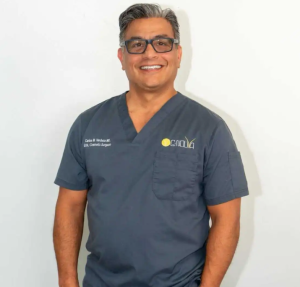
Dr. Carlos M. Verdeza is a board certified gynecologist and founder of G-Nouva, a women’s wellness and longevity clinic in Doral, Miami. Over 15 years of experience in integrative gynecology, hormone optimization, menopause management, cosmetic gynecology, and regenerative women’s wellness. Full bio at gnouva.com/our-authors/dr-carlos-m-verdeza.