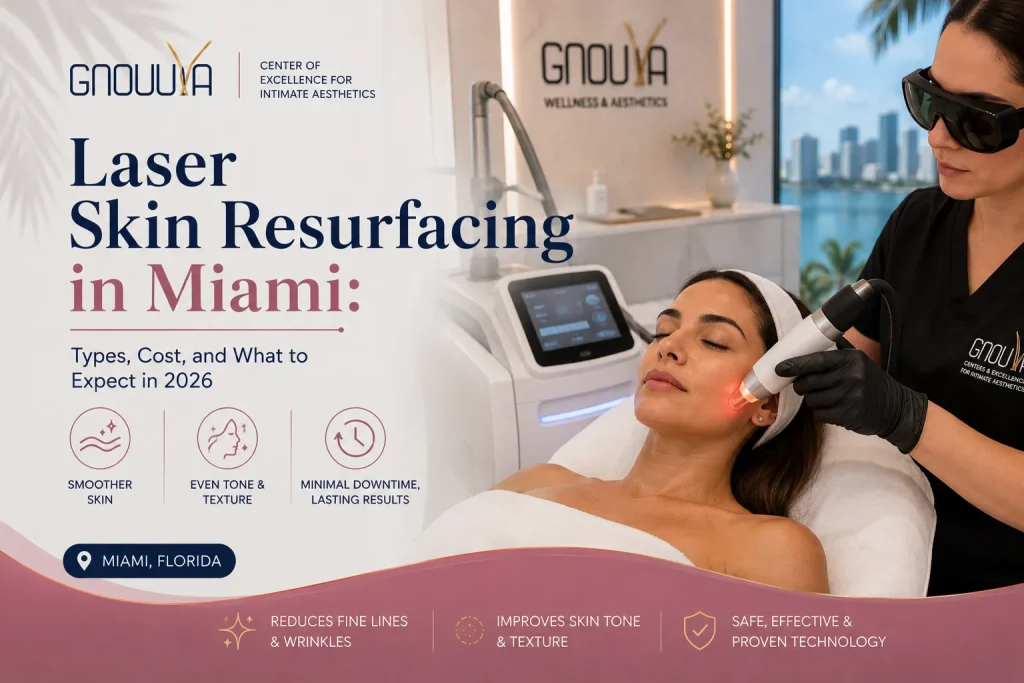
Miami is one of the leading US markets for laser skin resurfacing, and for good reason. The combination of sun exposure, cultural attention to appearance, and access to advanced technology has made the city a major hub for aesthetic care. Women and men across Miami, Coral Gables, Miami Beach, Kendall, and Doral are turning to laser resurfacing to address sun damage, fine lines, acne scars, uneven texture, and general skin quality.
The category has also become confusing. Different laser technologies produce different results, target different concerns, and involve different downtime. Choosing the right treatment requires understanding what each type actually does. For our specific laser resurfacing offerings, see our laser skin resurfacing page.
What Is Laser Skin Resurfacing?
Laser skin resurfacing is a treatment that uses focused laser energy to remove damaged surface skin cells and stimulate the growth of new collagen, elastin, and healthy skin tissue. It addresses concerns that topical products and simple facials cannot reach.
The technology has evolved dramatically. Modern laser resurfacing can be tuned for aggressive one time treatments with significant downtime, or gentler series of treatments with minimal downtime, or anything in between. The right choice depends on what you are trying to address, how much downtime you can afford, and your skin type.
Not all lasers are the same. A treatment that dramatically improves one person’s skin can be wrong for another. Understanding which laser targets your specific concern is essential.
What Are the Main Types of Laser Skin Resurfacing?
Ablative CO2 Laser
The most aggressive category. CO2 laser removes entire layers of surface skin at once, producing dramatic improvement in one treatment. Best for significant sun damage, deep wrinkles, and moderate acne scarring. Downtime is 7 to 14 days with visible healing. Not appropriate for all skin tones due to pigmentation risk.
Fractional CO2 Laser
A modernized version of traditional CO2. Instead of ablating the entire surface, it treats microscopic columns of tissue with unaffected skin between them. This produces strong results with meaningfully less downtime, typically 5 to 7 days. The workhorse of modern ablative resurfacing.
Erbium Laser
Similar in category to CO2 but with different tissue interaction. Best for lighter surface work and better tolerated by some skin types than CO2. Slightly less dramatic result but also less downtime.
Non-Ablative Fractional Laser
Does not remove tissue at all. Instead, it heats deeper layers to stimulate remodeling while leaving the surface intact. Multiple treatments (typically 3 to 5) are needed for meaningful result. Almost no downtime. Best for maintenance and mild concerns.
IPL and Photofacial
Not technically laser resurfacing but often grouped with it. Uses broad spectrum light to target pigmentation and vascular concerns. Good for sun damage, redness, and mild texture. Minimal downtime, multiple sessions needed.
Who Is a Good Candidate for Laser Resurfacing?
The right candidate for laser resurfacing depends on the specific concern and skin type.
- Sun damage: excellent candidate for fractional CO2 or IPL depending on severity
- Fine lines and moderate wrinkles: good candidate for fractional CO2
- Deep wrinkles: may benefit from full ablative CO2 if skin type appropriate
- Acne scars: fractional CO2 or non ablative fractional laser depending on scar type
- Uneven texture: multiple options work; choice depends on downtime tolerance
- Melasma: cautious selection needed; wrong laser can worsen melasma
- Rosacea and redness: IPL or specific vascular lasers rather than resurfacing
- Darker skin tones: require specific laser selection and lower settings to avoid pigmentation changes
Skin type assessment (Fitzpatrick scale) is a critical part of laser consultation. The same laser that produces excellent results in one skin type can cause pigmentation changes in another.
How Much Does Laser Skin Resurfacing Cost in Miami?
Typical Miami metro pricing in 2026:
- Full ablative CO2 (one session): 3,000 to 6,000 dollars
- Fractional CO2 (per session): 1,200 to 2,500 dollars, typically 1 to 3 sessions
- Erbium laser (per session): 1,000 to 2,000 dollars
- Non ablative fractional (per session): 500 to 1,200 dollars, typically 3 to 5 sessions
- IPL / BBL photofacial (per session): 350 to 700 dollars, typically 3 to 5 sessions
- Combined treatments (laser plus PRP): 1,500 to 3,000 dollars per session
Pricing packages for multiple sessions typically offer 10 to 20 percent savings versus buying sessions individually. Bundled treatments with PRP treatment for enhanced results are also common. Miami tends to run in the middle of major US metro pricing.
What Should You Expect During and After Treatment?
Preparation
Avoid sun exposure for 2 to 4 weeks before treatment. Discontinue retinoids and glycolic acids 1 to 2 weeks prior. Some providers prescribe pre treatment topical medication to reduce risk of pigmentation changes, especially for darker skin tones.
The Treatment
Topical numbing cream is applied 30 to 60 minutes before treatment. For aggressive treatments, oral sedation or nerve blocks may be added. The treatment itself takes 30 to 90 minutes depending on area and laser type.
Immediate Aftermath
Ablative treatments produce significant redness, swelling, and a raw appearance for the first 3 to 5 days. Fractional treatments produce redness and swelling for 3 to 7 days that gradually improves. Non ablative treatments have minimal visible aftermath.
The Following Weeks
Peeling and flaking during the healing phase. Strict sun avoidance and daily SPF 50+ for at least 6 to 8 weeks. Continued gentle skincare per provider instructions. Results start to be visible at 2 to 4 weeks and continue to improve for 3 to 6 months as new collagen forms.
The single biggest determinant of post laser results is sun protection during the healing phase. Skipping SPF can undo months of skin building and can trigger pigmentation problems that are hard to reverse.
What Should You Look for in a Miami Provider?
Laser resurfacing quality varies significantly by provider. Look for:
- Board certified physician oversight
- Multiple laser technologies available so treatment can be matched to your concern
- Experience with your specific skin type
- Willingness to say no when laser is not the right tool
- Realistic outcome expectations rather than dramatic promises
- Clear post treatment support and follow up
- Combined treatment options (laser plus PRP, laser plus microneedling) when appropriate
Med spas offering laser treatments without qualified physician oversight are a real concern in Miami. Quality matters more here than in most aesthetic categories because wrong settings can cause permanent skin damage. Practices offering laser resurfacing alongside broader aesthetic services like female rhinoplasty or comprehensive in office procedures typically bring the physician oversight and coordinated care model that produces the best outcomes.
When Is Laser Not the Right Answer?
Laser resurfacing is a powerful tool but not universal. Cases where it is not the right first choice:
- Deep facial aging with significant tissue loss (surgical options like facelift or neck lift may produce better results)
- Active acne or severe rosacea (needs to be controlled first)
- Recent Accutane use (typically requires 6 to 12 months off before laser)
- Very darker skin tones without provider experience in appropriate laser selection
- Patients who cannot commit to sun avoidance during healing
- Pregnancy or breastfeeding for aggressive treatments
For patients where laser is not enough for their concerns, surgical options can produce more meaningful change. For example, patients considering broader aesthetic work might also explore procedures like neck lift for age related neck changes that laser cannot fully address.
Frequently Asked Questions
What is the difference between ablative and non-ablative laser?
Ablative lasers remove surface skin tissue. They produce more dramatic results but have more downtime (5 to 14 days). Non ablative lasers heat tissue without removing it. They have less downtime but need more sessions for comparable results.
Is laser skin resurfacing safe for darker skin tones?
Yes with the right laser and settings. Certain lasers (like fractional CO2 at lower settings) work well for darker skin when combined with pre treatment protocols. Provider experience with your specific skin type is critical.
How long do laser resurfacing results last?
Results from a full ablative treatment can last 5 to 10 years with good sun protection. Fractional treatment results typically last 3 to 7 years. Non ablative and IPL results need maintenance every 12 to 18 months. Aging continues in all cases; no laser stops time.
Can I do laser resurfacing in summer?
It is generally better to schedule in fall, winter, or spring when sun exposure is easier to control. Summer treatments are possible but require stricter sun avoidance during healing.
How is laser different from microneedling?
Both stimulate collagen but through different mechanisms. Microneedling uses tiny needles to create channels; laser uses light energy to heat or remove tissue. Laser generally produces stronger results but with more downtime. Both are legitimate tools for different concerns.
Can I combine laser with other treatments?
Yes, combinations are common. Laser plus PRP is well established. Laser plus microneedling in different sessions can compound results. Fillers or Botox before or after laser depend on timing. Discuss any combination plan with an experienced provider.
Curious whether laser skin resurfacing is right for your skin concerns? Book an aesthetic consultation with our team at G-Nouva in Doral, Miami. Call (786) 453-2785 or visit gnouva.com/contact.
Related Reading
About the Author
The G-Nouva team includes board certified providers offering integrative women’s wellness, cosmetic gynecology, and aesthetic care in Doral, Miami. Learn more at gnouva.com.