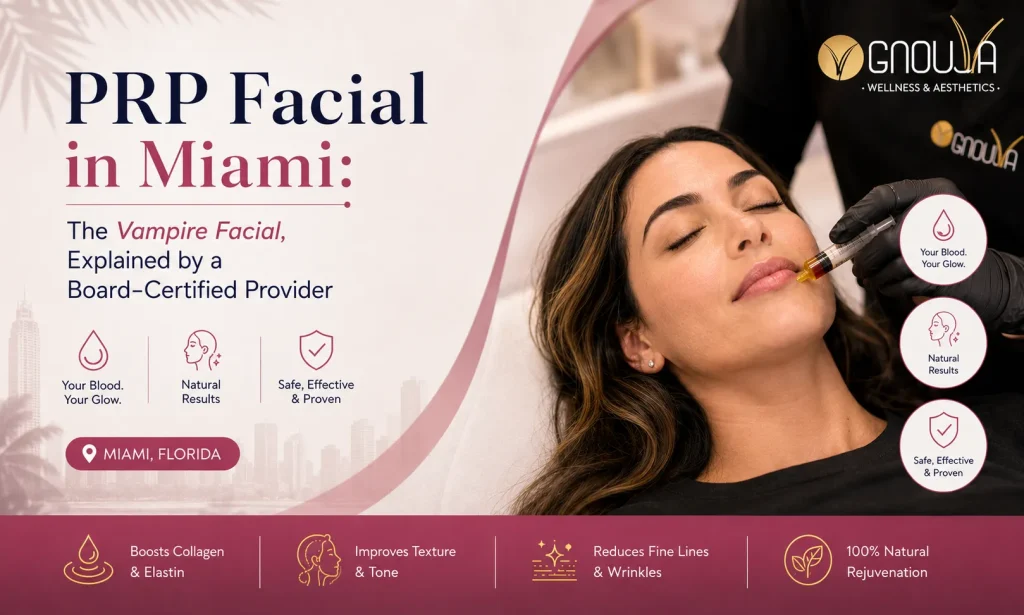
The PRP facial, popularly known as the vampire facial, has become one of the most requested aesthetic treatments in Miami. The name is dramatic. The procedure is not. It is a legitimate regenerative aesthetic treatment backed by clinical evidence that uses the patient’s own blood components to stimulate skin renewal, without synthetic products or injections of foreign material.
This guide covers what a PRP facial actually is, how it works, who benefits, what to expect, what it costs in Miami, and how it fits alongside other aesthetic treatments. For our full page on PRP applications, see our PRP treatment resource.
What Is a PRP Facial?
A PRP facial is a facial rejuvenation treatment that uses platelet rich plasma derived from the patient’s own blood. A small volume of blood is drawn from the arm. That blood is spun in a centrifuge to separate the components. The concentrated platelets are collected and either applied topically after microneedling or injected into specific facial areas.
Platelets contain natural growth factors and signaling molecules the body uses for tissue repair and regeneration. When those concentrated growth factors are delivered to the skin, they stimulate collagen production, improve blood vessel formation, and support skin renewal from within.
The nickname “vampire facial” came from the popular version that uses microneedling to create tiny channels in the skin, followed by application of PRP that can look reddish. The name is theatrical. The procedure itself is straightforward.
PRP is autologous, meaning it comes from your own body. This eliminates concerns about allergic reactions or rejection that apply to some other cosmetic treatments.
How Does the PRP Facial Work?
The treatment involves several steps that typically take 60 to 90 minutes total in office.
Blood Draw
A small volume of blood (10 to 30 ml, depending on the protocol) is drawn from the arm, similar to a routine lab draw.
Centrifuge Processing
The blood is spun in a centrifuge to separate red blood cells from plasma and platelets. The platelet rich plasma is collected while other components are discarded. The quality of centrifuge and technique used affects platelet concentration significantly.
Microneedling (Optional but Common)
The skin is numbed with topical anesthesia. A microneedling device creates tiny channels in the surface skin, which improves PRP absorption and adds its own collagen stimulating effect. The channels close quickly after treatment.
PRP Application
The PRP is applied topically over the microneedled skin, or injected directly into specific areas depending on the protocol. Injection PRP typically targets deeper concerns like under eye hollows or specific lines.
What Does a PRP Facial Actually Do for Your Skin?
The clinically documented benefits of PRP facials include:
- Improvement in skin texture and smoothness
- Reduction in fine lines and early wrinkles
- Improved skin tone and radiance
- Reduction in mild acne scarring over multiple sessions
- Improvement in skin hydration and elasticity
- Support for hair regrowth when applied to the scalp
- Enhanced results when combined with other treatments like laser
PRP is not the right tool for deep wrinkles, significant sagging, or extensive sun damage. For those concerns, combining PRP with modalities like laser skin resurfacing produces stronger results than either alone. Combined treatment protocols are common in Miami practices offering both.
Who Is a Good Candidate for a PRP Facial?
The ideal PRP facial candidate typically has:
- Mild to moderate skin quality concerns rather than dramatic aging
- Fine lines, uneven texture, or dull skin
- Mild acne scarring
- Post inflammatory hyperpigmentation from acne
- Interest in natural regenerative treatments rather than synthetic fillers
- Realistic expectations for gradual improvement over multiple sessions
- Good general health and adequate protein intake to support tissue building
Patients with active infections at the treatment site, certain blood conditions, or those on strong anti coagulant medication may not be appropriate candidates. This is discussed during consultation.
How Much Does a PRP Facial Cost in Miami?
Typical Miami metro pricing in 2026:
- Single PRP facial (with microneedling): 600 to 1,200 dollars
- Package of 3 sessions: 1,600 to 3,200 dollars
- PRP injections for specific concerns: 800 to 1,500 dollars per session
- PRP combined with fractional laser: 1,500 to 3,000 dollars per session
- PRP for scalp and hair (separate service): 500 to 1,000 dollars per session
Package pricing typically saves 15 to 25 percent versus per session pricing. Most protocols recommend 3 sessions spaced 4 to 6 weeks apart, with maintenance every 6 to 12 months.
What Should You Expect During Recovery?
PRP facial recovery is minimal compared to more aggressive treatments.
- Immediate: mild redness, minor pinpoint bleeding from microneedling, occasional mild swelling
- Day 1 to 2: continued mild redness resembling a mild sunburn, sometimes slight peeling
- Day 3 to 5: redness resolved, skin may look slightly dry, makeup can typically be worn again
- Days 7 to 14: initial skin quality improvements start to appear
- Weeks 4 to 8: results build progressively as new collagen forms
- Months 2 to 6: best results after a complete series of treatments
Post treatment care includes gentle skincare, no direct sun exposure for 5 to 7 days, and daily SPF 50+ for at least 2 weeks. Following these instructions substantially affects the final result.
What Should You Look for in a Miami PRP Provider?
PRP treatment quality varies significantly across providers. Key factors:
- Physician oversight, not just aesthetician performing the procedure
- Quality centrifuge that actually produces concentrated PRP
- Sterile technique throughout blood draw, processing, and application
- Clear protocol description including number of sessions expected
- Realistic expectations set from the start
- Coordination with other aesthetic treatments when appropriate
The quality of PRP varies significantly across clinics based on centrifuge equipment and preparation technique. Two treatments that look identical on paper can produce very different results based on how well the PRP was prepared. Practices that integrate PRP into broader aesthetic and wellness care, such as those offering combined services with female rhinoplasty or comprehensive in office procedures, typically bring the physician oversight and coordinated care that produces the best outcomes.
How Does PRP Compare to Other Aesthetic Treatments?
PRP has its own niche. Understanding how it compares helps set expectations.
- PRP vs Botox: totally different tools. Botox relaxes muscle activity to reduce dynamic wrinkles. PRP stimulates skin regeneration. They target different concerns and are often used together
- PRP vs fillers: fillers restore volume immediately. PRP builds skin quality gradually. Together they can address both volume and texture
- PRP vs laser: laser produces stronger results faster but with more downtime. PRP offers gentle improvement with almost no downtime. Combined treatments compound benefits
- PRP vs microneedling alone: adding PRP to microneedling produces stronger results than microneedling alone. Cost is higher but results are meaningfully better in most patients
Beyond facial applications, PRP is used for hair restoration and for PRP intimate wellness. Providers offering PRP across multiple applications typically bring more experience with the technology overall.
Frequently Asked Questions
Does a PRP facial hurt?
The blood draw is standard and brief. The microneedling portion is done with topical numbing cream. Most patients describe mild discomfort rather than pain. The face may feel warm during and after treatment but is not typically painful.
How many PRP facial sessions do I need?
Most protocols recommend 3 sessions spaced 4 to 6 weeks apart for meaningful visible results. Maintenance treatments every 6 to 12 months help sustain the gains. Some patients benefit from more or fewer sessions based on their specific concerns.
When will I see PRP facial results?
Initial improvements in skin quality typically appear at 2 to 4 weeks after the first session. Best results are seen at 3 to 6 months after completing a full series, as new collagen continues to form.
Is a PRP facial safe?
Yes when performed by qualified providers using sterile technique. Because the material is derived from your own blood, there is no risk of allergic reaction or rejection. Standard risks include mild bruising, temporary redness, and rare infection risk.
Can I combine PRP with other treatments?
Yes. Common combinations include PRP with fractional laser (for stronger results), PRP with fillers (volume plus quality), or PRP with Botox (relaxation plus regeneration). Combined protocols are often more effective than single modality treatments.
Does PRP work for acne scars?
PRP can help improve mild to moderate acne scarring over multiple sessions, particularly when combined with microneedling or fractional laser. For deep boxcar or ice pick scars, more aggressive treatments are usually needed.
Curious whether a PRP facial fits your aesthetic goals? Book a consultation with our team at G-Nouva in Doral, Miami. Call (786) 453-2785 or visit gnouva.com/contact.
Related Reading
About the Author
The team at G-Nouva in Doral, Miami includes board certified providers offering integrative women’s wellness, cosmetic gynecology, and regenerative aesthetic care. Learn more at gnouva.com.