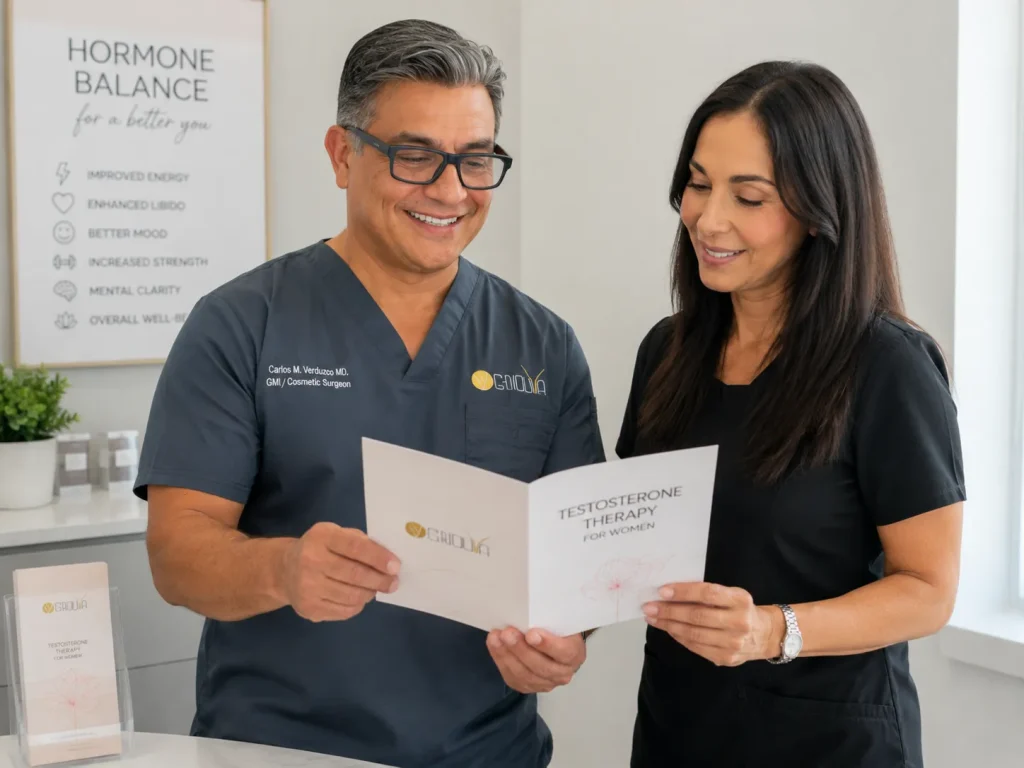
For decades, testosterone was treated as a male hormone. Women have it too, in smaller amounts, and it does some of the most important work in the female body. It affects libido, energy, mood, muscle mass, bone density, cognitive function, and how a woman feels in her own skin. When testosterone declines, which happens naturally with age and accelerates around perimenopause, the impact is real.
Testosterone therapy for women has been around for a long time and is increasingly recognized as a legitimate, evidence based part of hormone care. It is still underused, partly because most doctors were not trained in it, and partly because the FDA has not approved a testosterone product specifically for women in the United States (though it has in other countries).
This guide explains what testosterone does for women, the signs of low testosterone, the different delivery methods, what to expect from treatment, real side effects, and how to know if it is right for you. It pairs with our broader work on hormone optimization for women in Miami for the full hormone picture.
What Testosterone Does for Women
Testosterone in women plays many of the same roles it does in men, just at lower levels. The most relevant ones for hormone therapy are:
- Sexual function: libido, arousal, sensitivity, ability to reach orgasm
- Energy and stamina, particularly through the afternoon
- Mood stability and motivation
- Cognitive function, focus, and mental sharpness
- Lean muscle mass and the ability to recover from exercise
- Bone density, especially in older women
- Vaginal tissue health alongside estrogen
- Skin elasticity and hair quality
Testosterone is the most consistent hormone for restoring libido in women in midlife. Patients who have tried everything else for low libido often find that adding properly dosed testosterone is what finally moves the needle. Our full breakdown of the medical causes of low libido in women covers this in detail.
Signs of Low Testosterone in Women
Low testosterone in women is often missed because the symptoms overlap with so many other conditions. Common signs include:
- Low libido, even when relationship and stress factors are fine
- Difficulty reaching orgasm or reduced sensitivity
- Persistent fatigue that does not respond to sleep
- Loss of muscle tone despite exercise
- Increased belly fat that resists diet and training
- Brain fog, word finding issues, slower thinking
- Low motivation and reduced drive
- Mood changes, particularly flatness or low mood
- Thinning hair, especially at the temples
No single symptom proves low testosterone. The pattern matters. Women with three or more of these symptoms whose labs confirm low free testosterone are usually good candidates for evaluation. Many of these symptoms also overlap with perimenopause, so we recommend cross referencing with our perimenopause symptoms checklist to see the full picture.
When Testosterone Declines
Testosterone in women peaks in the mid 20s. It declines gradually through the 30s and 40s. By menopause, total testosterone may be roughly half of what it was at peak. Some women experience a sharper drop. Surgical menopause (removal of ovaries) causes an immediate and dramatic decline. Chronic stress, certain birth control formulations, and some antidepressants also lower testosterone.
The classic pattern we see in clinic: a woman in her mid 40s notices that libido has dropped substantially. Her workouts feel harder. She is gaining belly fat. Her mood is flatter. Her doctor checks “testosterone” and reports normal. The number is normal for a 65 year old, not for her age and symptoms.
The Right Labs to Run
A real testosterone workup in women includes:
- Total testosterone
- Free testosterone (the active, bioavailable form)
- SHBG (sex hormone binding globulin) which binds testosterone and reduces free levels
- DHEA-S (the adrenal precursor to testosterone)
- Estradiol (since testosterone and estrogen work together)
- Progesterone (in cycling women)
- Full thyroid panel (low thyroid mimics low testosterone)
Free testosterone is the most useful number for women because total can look normal while SHBG is binding most of it, leaving very little available to the body. Our full guide on the complete hormone panel for women explains what each of these labs actually means and why timing matters.
Delivery Methods Available for Women
Transdermal Cream
Compounded testosterone cream applied daily to the skin. Pros: flexible dosing, easy to start and stop, low cost. Cons: requires daily routine, transfer risk to partners or children, absorption can vary based on skin type.
Pellets
Small subcutaneous pellets placed in the upper buttock every 3 to 4 months for women. Pros: steadiest blood levels, no daily routine, often achieves therapeutic levels that creams cannot. Cons: less flexible to adjust mid cycle, requires office procedure. Full detail in our bioidentical hormone pellet therapy guide.
Subcutaneous Injections
Very small testosterone injections given weekly or twice weekly. Pros: flexible dosing, predictable blood levels when done correctly, lower cost than pellets long term. Cons: requires self injection (small needle, fairly easy after the first time).
What We Do Not Recommend for Women
Male dose testosterone in any form. Standard testosterone patches or gels designed for men deliver many times the dose women need. Anabolic steroid pellets or injections sold by some unsupervised clinics. Online providers who prescribe without labs or follow up.
Real Side Effects, Honestly
When testosterone is dosed correctly for women, side effects are usually mild and manageable. They become more likely when doses are too high or not adjusted based on follow up labs.
- Acne or oilier skin, usually mild and temporary
- Slight increase in unwanted facial or body hair (varies by genetics)
- Rare scalp hair thinning in genetically predisposed women
- Voice changes (very rare at properly dosed female levels)
- Mild mood changes in either direction during the first month
- Possible mild fluid retention
Long term safety of testosterone therapy in women is generally favorable when properly monitored. The broader safety conversation for hormone therapy in women is covered in our resource on whether HRT is safe for women in 2026.
The most common dosing mistake is giving too high a dose too fast. We start low, recheck labs in 6 to 8 weeks, and adjust. Patience in the first 2 to 3 months produces much better long term outcomes than aggressive dosing.
How Long It Takes to Work
Most women notice changes between week 3 and week 8. Energy and mood often improve first. Libido and sensitivity tend to shift around week 4 to 6. Muscle tone, body composition, and recovery benefits appear over 3 to 6 months of consistent therapy.
If a patient feels no different by week 8, the dose is usually too low, the delivery method is not absorbing well, or there is a separate issue (thyroid, sleep, relationship factors) that needs to be addressed alongside testosterone.
Testosterone Therapy Cost in Miami in 2026
Cost varies significantly by delivery method. Compounded testosterone cream typically runs 50 to 120 dollars per month from a quality compounding pharmacy. Pellets run 400 to 900 dollars per insertion every 3 to 4 months. Subcutaneous injections run 60 to 150 dollars per month including supplies.
Our pricing at G-Nouva bundles labs, consultation, the medication or procedure, and follow up.
Combining Testosterone with Other Treatments
Testosterone therapy is often most powerful when combined with other treatments addressing the same issues from different angles. For sexual health, testosterone plus the O-Shot can produce better results than either alone. For menopause, testosterone is one piece of a complete hormone plan that usually includes estradiol and progesterone, as covered in our menopause treatment guide resource.
Frequently Asked Questions
Is testosterone therapy safe for women?
When dosed appropriately for women (much lower than male doses) and monitored with labs every 3 to 6 months, testosterone therapy has a favorable safety profile for most women. The risks come from overdosing, lack of monitoring, and using formulations designed for men.
Will testosterone make me look masculine?
No, when dosed correctly for a woman. Female testosterone doses are 5 to 10 percent of male doses. Properly dosed testosterone helps with lean muscle, energy, and libido without masculinizing effects in nearly all patients.
Will testosterone help me lose weight?
It often helps with body composition (more lean muscle, less belly fat) when combined with strength training and adequate protein. It is not a weight loss drug. The scale may not drop dramatically, but body shape and how clothes fit usually improve.
How is testosterone different from DHEA?
DHEA is an adrenal hormone that the body can convert into testosterone (and estrogen). For some women with mild low T, DHEA alone is enough. For women with significant symptoms, direct testosterone is usually needed.
Can I do testosterone while I am still cycling?
Yes. Younger women with confirmed low testosterone and clear symptoms benefit from properly dosed testosterone. We use lower doses and monitor more carefully in still cycling patients.
Curious if low testosterone is behind your fatigue, low libido, or stalled progress? Book a full hormone evaluation with Dr. Verdeza at G-Nouva in Doral, Miami. Call (786) 453-2785 or visit gnouva.com/contact.
About the Author
Dr. Carlos M. Verdeza is a board certified gynecologist and the founder of G-Nouva, an integrative women’s wellness center in Doral, Miami. He has fifteen plus years of experience treating hormone imbalance, PCOS, perimenopause, and intimate wellness concerns. Full bio at gnouva.com/our-authors/dr-carlos-m-verdeza.