
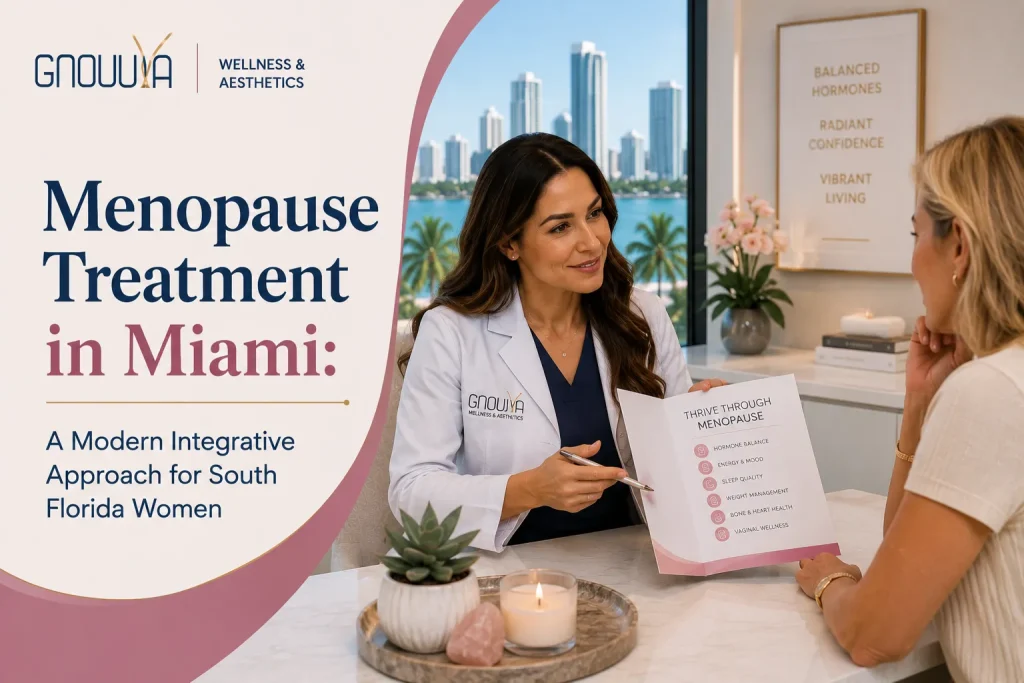
For decades menopause was treated as a phase to endure rather than a health condition to actively manage. That has changed dramatically. In 2026, comprehensive menopause care includes evidence based hormone therapy, non hormonal medical options, lifestyle medicine, vaginal health treatment, and coordination with other specialists. Miami has developed a growing community of providers offering this level of integrative care, replacing the older model of dismissing menopausal symptoms with “it is just menopause.”
This guide covers what modern menopause treatment in Miami actually looks like, what the evidence supports in 2026 after the major FDA HRT label changes, and how to find a provider who offers comprehensive rather than fragmented care. For our companion resource on the FDA HRT changes, see HRT after the FDA black box removal.
What Does Modern Menopause Treatment Include?
Comprehensive menopause care in 2026 is meaningfully different from the older model of prescribing an HRT patch and sending the patient home.
- Comprehensive hormonal evaluation with modern lab testing
- Individualized hormone therapy when appropriate, using modern formulations and delivery methods
- Vaginal health treatment including local estrogen and other options for genitourinary symptoms
- Non hormonal medical options for women who cannot or choose not to use HRT
- Metabolic evaluation and treatment for weight, insulin, and cardiovascular changes
- Sleep evaluation and targeted treatment for sleep disturbance
- Cognitive symptom evaluation and management
- Sexual health assessment and treatment options
- Bone density protection strategies
- Coordination with other specialists (dermatology, cardiology, mental health) as needed
- Lifestyle medicine including exercise prescription, nutrition, and stress management
Modern menopause care is comprehensive rather than symptom by symptom. The same provider who prescribes HRT should be thinking about your metabolic health, sleep, bone density, and quality of life as a coordinated picture.
What Changed in Menopause Care in 2025 and 2026?
Several major changes reshaped menopause care in the past year.
FDA Removed HRT Black Box Warning
In November 2025 the FDA removed boxed warnings from six systemic hormone therapy products. This formal correction of decades of misapplied warnings has dramatically shifted prescribing patterns. Our detailed resource on this at HRT after the FDA black box removal covers what specifically changed and why it matters.
Prescribing Patterns Have Doubled
Vaginal cream use is up more than 4x since 2018. Systemic HRT prescriptions have doubled. This reflects both greater awareness and reduced stigma around treatment. Providers who were reluctant to prescribe HRT in earlier years are increasingly returning to it as first line for appropriate patients.
Non Hormonal Options Have Expanded
Fezolinetant (an FDA approved non hormonal option for hot flashes) has become widely used. This provides an evidence based option for women who cannot or choose not to use HRT. Combined with cognitive behavioral therapy, gabapentin at bedtime, and SSRIs when appropriate, non hormonal management has become more robust.
The Timing Hypothesis Is Widely Accepted
The understanding that HRT started within 10 years of menopause has fundamentally different risk profile than late initiation has become standard. This favors earlier and more proactive discussion of treatment during perimenopause rather than waiting.
Integrative Approaches Have Become Mainstream
The old model of gynecologist as symptom prescriber has given way to integrative approaches that coordinate hormone therapy with metabolic, cognitive, and lifestyle interventions. Miami has been a leading market for this approach.
What Should a Menopause Consultation Actually Cover?
A quality menopause consultation should include:
- Detailed symptom review across all body systems (not just hot flashes)
- Complete medical history including family history of cancer and cardiovascular disease
- Review of current medications and supplements
- Physical exam appropriate to your case
- Comprehensive labs including baseline hormone panel (our complete hormone panel for women resource covers what should be tested)
- Discussion of your specific goals for treatment
- Discussion of hormone therapy candidacy based on individual risk factors
- Discussion of non hormonal options where relevant
- Discussion of lifestyle interventions and their role
- Clear treatment plan with expected timeline
- Follow up scheduling
Rushed 10 to 15 minute visits where you leave with an HRT prescription and no broader discussion are inadequate for menopause care. A thorough consultation typically takes 45 to 60 minutes.
What Are the Main Treatment Categories?
Systemic Hormone Replacement Therapy
Foundation of menopause treatment for many women. Modern approach favors transdermal estradiol (patch, gel, or spray) with micronized progesterone for women with a uterus. Duration and dose are individualized. Our resource on is HRT safe for women in 2026 covers modern HRT in depth.
Bioidentical Hormone Pellets
An alternative delivery method for women who prefer sustained release. Small compounded implants deliver estradiol and often testosterone over 3 to 4 months. Our page on bioidentical hormone pellet therapy covers this specific option.
Vaginal Estrogen for Local Symptoms
Highly effective for vaginal atrophy, painful intercourse, and recurrent UTIs. Very low systemic absorption makes it appropriate for many women including some who cannot use systemic HRT. Our detailed resource on vaginal estrogen in 2026 covers this in depth.
Non Hormonal Medical Options
Fezolinetant for hot flashes. SSRIs and SNRIs for vasomotor symptoms and mood. Gabapentin at bedtime for night sweats and sleep. Oxybutynin for hot flash reduction in specific cases. Each has appropriate patient profiles.
Lifestyle Medicine
Regular aerobic and resistance exercise. Nutrition focused on protein, vegetables, and blood sugar stability. Stress management and adequate sleep. These are foundational and improve outcomes regardless of medical interventions.
Weight and Metabolic Management
Perimenopausal weight gain and metabolic changes benefit from targeted care including nutrition, exercise, and in appropriate patients GLP-1 medications. Our resource on menopause weight gain covers this crossover.
What About Where in Miami You Get Care?
The Miami metro has developed several sub markets for women’s wellness and menopause care.
Doral
Growing hub for women’s wellness with concentration of integrative gynecology practices. Bilingual care available for Miami’s large Hispanic population. Accessible from Miami metro and surrounding areas.
Coral Gables
Concentrated aesthetic and cosmetic gynecology practices. Some offer comprehensive menopause care. Pricing tends to be higher end.
Miami Beach and Aventura
Some menopause specialists in these areas. Fewer than Doral or Coral Gables for comprehensive integrative care.
Kendall and Suburban Miami
Growing options for comprehensive care. Many patients travel to Doral or Coral Gables for specialized menopause treatment.
What Should You Look for in a Miami Menopause Specialist?
Not all gynecologists are equally trained in modern menopause management. Key criteria:
- Board certified gynecologist
- Specific training or certification in menopause management (Menopause Society Certified Practitioner or equivalent)
- Comfortable prescribing across the full range of options (HRT, non hormonal, lifestyle, pellets)
- Adequate consultation time (45+ minutes for initial visit)
- Integrative approach rather than symptom by symptom prescription
- Bilingual staff if English is not your first language
- Modern understanding of the FDA HRT changes and updated evidence
- Willingness to coordinate with other specialists (cardiology, endocrinology, mental health) when appropriate
- Clear follow up structure
For our approach specifically, see Dr. Verdeza’s bio and approach covering our medical team and philosophy.
What Should You Do Next?
If menopause symptoms are affecting your life and you have not had comprehensive evaluation, practical next steps:
- Book a consultation with a provider trained in modern menopause management (not just a general gynecologist who occasionally treats menopause)
- Bring a detailed symptom list ranked by impact on your life
- Bring your family history and current medications
- Read our perimenopause symptoms checklist to know what symptoms may warrant discussion
- Expect comprehensive evaluation including labs, exam, and detailed discussion
- Discuss all treatment options rather than accepting only one approach
- Set expectations for follow up and reassessment
- Understand that meaningful improvement typically takes 8 to 12 weeks of consistent treatment
- Our main hormone replacement therapy page covers our full range of hormone therapy services
Frequently Asked Questions
Where can I find a menopause specialist in Miami?
Board certified gynecologists with menopause training practice across Miami metro including Doral, Coral Gables, Miami Beach, Aventura, and Kendall. Doral has become a concentrated area for integrative women’s wellness care serving the entire Miami metro.
What does modern menopause treatment include?
Comprehensive care includes hormone therapy when appropriate, vaginal health treatment, non hormonal medical options, metabolic and cardiovascular evaluation, sleep assessment, cognitive symptom management, bone density protection, and lifestyle medicine. Modern approach is integrative rather than symptom by symptom.
Is HRT prescribed differently in Miami than other cities?
The standard of care is similar across major US metros for modern menopause practices. Miami’s advantage is a concentration of practices offering integrative care including hormone therapy, cosmetic gynecology, and aesthetic services under coordinated care models.
How much does menopause treatment cost in Miami?
Initial consultation typically 300 to 500 dollars for comprehensive evaluation. Monthly HRT costs range from insurance copay to 50 to 200 dollars for FDA approved products. Pellet therapy typically 300 to 600 per insertion done 3 to 4 times per year. Labs and follow ups additional. Insurance coverage varies significantly by plan.
Do I need to be in menopause to seek menopause care?
No. Perimenopause (the transitional years before menopause) often has more disruptive symptoms than menopause itself. Comprehensive care during perimenopause is often the most impactful time to seek treatment. Do not wait until you have missed 12 months of periods.
Can I do menopause treatment in Miami if I do not want HRT?
Yes. A comprehensive menopause practice offers robust non hormonal options including fezolinetant, SSRIs, gabapentin, cognitive behavioral therapy, lifestyle medicine, and targeted symptom management. Not all women are candidates for or choose HRT.
Ready for comprehensive menopause care in Miami? Book a consultation with Dr. Verdeza at G-Nouva in Doral. Call (786) 453-2785 or visit gnouva.com/contact.
About the Author
Dr. Carlos M. Verdeza is a board certified gynecologist and the founder of G-Nouva, an integrative women’s wellness and cosmetic gynecology center in Doral, Miami. He has fifteen plus years of experience in women’s hormone care, menopause management, cosmetic gynecology, and metabolic optimization. Full bio at gnouva.com/our-authors/dr-carlos-m-verdeza.