
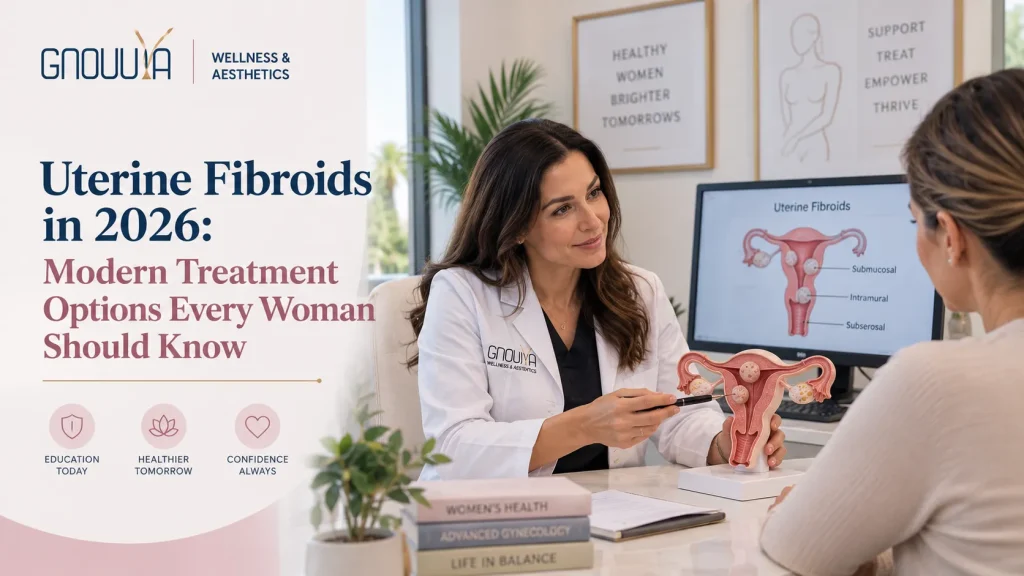
Uterine fibroids are one of the most common conditions in women’s health, affecting up to 80 percent of women by menopause. Yet they remain one of the least discussed and most confusing topics for many patients. The good news is that treatment options have expanded dramatically over the past decade. What used to be a binary choice between hysterectomy and doing nothing is now a nuanced spectrum of medications, minimally invasive procedures, and surgical options tailored to each patient’s specific situation, fertility goals, and preferences.
This guide covers what uterine fibroids actually are, how they cause problems, the full range of modern treatment options in 2026, and how to make an informed decision about care. For our broader gynecology page, see our gynecology practice page.
What Are Uterine Fibroids and Why Are They So Common?
Uterine fibroids are benign (non cancerous) tumors that grow in or on the wall of the uterus. They are made of smooth muscle tissue and connective tissue and can range from microscopic to grapefruit sized or larger. They are extremely common: up to 80 percent of women develop at least one fibroid by menopause, though many never know because they are asymptomatic.
Fibroids are classified by their location in the uterine wall:
- Submucosal: grow into the uterine cavity, often cause heavy bleeding and fertility issues
- Intramural: grow within the muscle wall of the uterus, most common type
- Subserosal: grow on the outer surface of the uterus, may cause pressure symptoms
- Pedunculated: grow on a stalk from the uterus, can twist and cause acute pain
- Cervical: rare, grow in the cervix rather than uterine body
Location matters as much as size for determining symptoms. A small submucosal fibroid can cause dramatic bleeding while a large subserosal fibroid may cause almost no symptoms.
Not every fibroid needs treatment. Small asymptomatic fibroids are extremely common and often followed rather than treated. Treatment is typically reserved for fibroids causing symptoms or fertility issues.
Who Gets Fibroids?
Fibroids can affect any woman of reproductive age, but certain factors increase risk.
- Age: reproductive age (20s to 50s), peaks in 40s and early 50s
- Ancestry: African American women have significantly higher incidence, earlier onset, and typically larger fibroids
- Family history: strong genetic component; having a mother or sister with fibroids increases risk
- Obesity: increased BMI associated with higher fibroid risk
- Never having given birth (nulliparity): pregnancy appears somewhat protective
- Early menarche (first period before age 10)
- Vitamin D deficiency has been associated with higher risk
- Certain dietary patterns (high red meat, low vegetable diets) have been associated with higher risk
Fibroids typically stop growing and often shrink after menopause because they are influenced by estrogen and progesterone. Postmenopausal fibroid growth is unusual and warrants evaluation.
What Symptoms Do Fibroids Cause?
The majority of fibroids are asymptomatic. When they do cause symptoms, common presentations include:
- Heavy menstrual bleeding, sometimes with clots
- Prolonged periods (longer than 7 days)
- Pelvic pain, pressure, or heaviness
- Urinary frequency or urgency (from pressure on bladder)
- Constipation (from pressure on rectum)
- Painful intercourse
- Lower back pain
- Abdominal enlargement or feeling of fullness
- Anemia from chronic heavy bleeding
- Fertility issues in some cases depending on fibroid location
- Complications during pregnancy for some patients
The impact of symptoms varies enormously. Some women have massive fibroids without significant symptoms. Others have small fibroids causing debilitating bleeding. Individual patient experience is what matters for treatment decisions.
How Are Fibroids Diagnosed?
Diagnosis typically follows a clear sequence.
- Detailed history of symptoms including menstrual patterns
- Physical exam including pelvic exam, sometimes reveals enlarged uterus. Our resource on the modern annual women’s wellness exam covers when pelvic exam is appropriate
- Pelvic ultrasound: usually first line imaging, transvaginal ultrasound provides best detail
- MRI: for complex cases, fertility planning, or when surgical planning requires precise mapping
- Sonohysterography: saline infused sonogram for evaluating uterine cavity
- Hysteroscopy: direct visualization of uterine cavity, useful for submucosal fibroids
- Complete blood count to check for anemia if heavy bleeding
- Comprehensive hormonal evaluation may be appropriate as part of treatment planning (our complete hormone panel covers this)
What Are the Modern Treatment Options?
Modern fibroid treatment is nuanced with multiple options across a spectrum from watchful waiting to definitive surgery.
Watchful Waiting
Appropriate for asymptomatic fibroids or minimally symptomatic fibroids in women approaching menopause when fibroids typically shrink naturally. Involves periodic monitoring with imaging and symptom review.
Hormonal Medications
Oral contraceptives and progestin therapy can help control bleeding. GnRH agonists (Lupron) shrink fibroids temporarily but have significant side effects. Newer oral GnRH antagonists (Oriahnn, Myfembree, Yselty) offer better tolerability with add back therapy. Progestin releasing IUD (Mirena) reduces heavy bleeding effectively for many women.
Non-Hormonal Bleeding Management
Tranexamic acid reduces bleeding without hormonal effects. Nonsteroidal anti inflammatories reduce bleeding and cramping. Iron supplementation addresses anemia from chronic heavy bleeding.
Uterine Artery Embolization
Interventional radiology procedure that blocks blood supply to fibroids, causing them to shrink. Preserves uterus. Minimally invasive with typically 1 to 2 day recovery. Not ideal for women wanting future pregnancy.
MRI Guided Focused Ultrasound
Non invasive procedure using focused ultrasound waves guided by MRI to destroy fibroid tissue. No incisions, no anesthesia in most cases. Not available at all centers. Best for specific fibroid types and locations.
Radiofrequency Ablation
Laparoscopic or transcervical delivery of radiofrequency energy to destroy fibroid tissue. Uterus preserved. Minimally invasive with faster recovery than traditional surgery.
Myomectomy (Fibroid Removal)
Surgical removal of fibroids while preserving the uterus. Can be performed through hysteroscopy (for submucosal), laparoscopy (for many others), or open abdominal surgery (for large or numerous fibroids). Preserves fertility. Recovery depends on approach used.
Hysterectomy
Definitive treatment removing the uterus entirely. Eliminates fibroid recurrence completely. Multiple approaches available (vaginal, laparoscopic, robotic, open). Appropriate when fertility preservation is not desired and conservative treatments have failed or are inappropriate.
How Do You Choose the Right Treatment?
Treatment selection depends on multiple factors that should be discussed comprehensively.
- Severity and type of symptoms
- Size, number, and location of fibroids
- Desire for future fertility
- Age and proximity to menopause
- Overall health and surgical risk
- Personal preferences about surgery versus medication versus procedures
- Response to previously tried treatments
- Time available for recovery
- Insurance coverage and cost considerations
- Provider experience with specific techniques
The right treatment is highly individualized. A woman with a single small submucosal fibroid causing heavy bleeding wanting future pregnancy has a very different optimal plan than a woman with multiple large fibroids near menopause who has completed her family. Both are legitimate cases requiring different approaches.
What About Fibroids and Fertility?
Fibroids and fertility is a nuanced area worth specific discussion.
- Submucosal fibroids (in the uterine cavity) most commonly affect fertility and are typically recommended for removal before fertility treatment
- Intramural fibroids larger than 4 cm may affect fertility and warrant discussion about removal
- Small subserosal fibroids typically do not affect fertility
- Myomectomy (fibroid removal preserving uterus) is the fertility preserving surgical option
- Uterine artery embolization is generally not recommended for women wanting future pregnancy
- MRI guided focused ultrasound and radiofrequency ablation have limited data for fertility patients
- Coordination with reproductive endocrinology often appropriate for complex cases
What About Perimenopause and Menopause?
Fibroids and the menopausal transition intersect in important ways. For patients approaching menopause with fibroids, understanding the trajectory helps guide treatment decisions. Our perimenopause symptoms checklist covers the broader perimenopause context.
- Fibroids typically stop growing and often shrink after menopause because estrogen drops
- Heavy bleeding from fibroids often improves after menopause
- Patients close to menopause with symptomatic fibroids may benefit from temporary hormonal treatments to bridge them through the transition
- Postmenopausal fibroid growth is unusual and warrants evaluation to exclude other diagnoses
- HRT decisions in patients with prior fibroids require individualized discussion. Our menopause treatment guide covers modern HRT approach
What Should You Do Next?
If you have symptomatic fibroids or have been told you have fibroids and need guidance, practical next steps:
- Book a comprehensive consultation with a gynecologist who offers the full range of fibroid treatment options (not just surgery)
- Bring records of any prior imaging and prior treatments tried
- Bring a detailed symptom log including bleeding patterns
- Discuss all treatment options rather than accepting only one approach
- Consider getting a second opinion for major treatment decisions like hysterectomy
- Understand that some fibroids are best watched rather than treated aggressively
- For fertility considerations, coordinate with reproductive endocrinology when appropriate
- Establish ongoing care with a provider who will monitor your case over time. Our gynecology page covers what to look for in comprehensive gynecologic care
Frequently Asked Questions
How common are uterine fibroids?
Extremely common. Up to 80 percent of women develop at least one fibroid by menopause. Many remain asymptomatic. Prevalence is higher and onset earlier in African American women. Fibroids are one of the most common conditions in women’s health.
Do all fibroids need treatment?
No. Most fibroids do not require treatment. Treatment is typically reserved for fibroids causing significant symptoms (heavy bleeding, pelvic pain, pressure symptoms) or affecting fertility. Small asymptomatic fibroids are typically followed rather than treated.
Can fibroids become cancerous?
Uterine fibroids are benign and do not become cancerous. Extremely rarely (less than 1 in 1000 cases) what appears to be a fibroid turns out to be a uterine sarcoma, a different cancerous tumor. Rapid growth, postmenopausal growth, or unusual imaging features warrant additional evaluation to exclude this rare possibility.
Can I get pregnant with fibroids?
Yes, most women with fibroids can conceive and carry pregnancies successfully. Submucosal fibroids (in the uterine cavity) most commonly affect fertility and are often removed before fertility treatment. Larger intramural fibroids may warrant removal in some cases. Small fibroids typically do not affect fertility.
What is the difference between myomectomy and hysterectomy?
Myomectomy removes fibroids while preserving the uterus, allowing future fertility. Hysterectomy removes the entire uterus, providing definitive treatment but eliminating fertility. Both are appropriate in different situations. Myomectomy is preferred when fertility is desired; hysterectomy for definitive treatment when fertility is not desired.
Do fibroids go away after menopause?
Fibroids typically stop growing and often shrink after menopause because they are influenced by estrogen. Symptoms including heavy bleeding often improve substantially. Some fibroids remain but usually cause less trouble. Postmenopausal fibroid growth is unusual and warrants evaluation.
Dealing with fibroid symptoms or need guidance on treatment options? Book a comprehensive consultation with Dr. Verdeza at G-Nouva in Doral, Miami. Call (786) 453-2785 or visit gnouva.com/contact.
Related Reading
About the Author
Dr. Carlos M. Verdeza is a board certified gynecologist and the founder of G-Nouva, an integrative women’s wellness and cosmetic gynecology center in Doral, Miami. He has fifteen plus years of experience in women’s hormone care, menopause management, cosmetic gynecology, and metabolic optimization. Full bio at gnouva.com/our-authors/dr-carlos-m-verdeza.